Trust Icons: The Visual Language of Credibility in Modern Design
Trust Icons have become a cornerstone of contemporary visual communication. In an era where audiences scan content in milliseconds, these simple, clean vector symbols serve as instant signals of reliability and professionalism. Whether embedded in a mobile app interface, a social media post, or a printed brochure, Trust Icons bridge the gap between aesthetic appeal and functional clarity. This article explores why these icons are gaining traction, how they fit into broader creative and business trends, and what makes them an essential asset for professionals across industries.
What Are Trust Icons and Why Do They Matter?
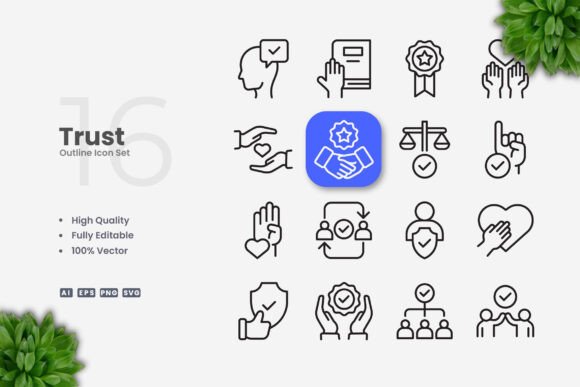
Trust Icons are a curated set of vector-based symbols designed to convey concepts like security, authenticity, approval, and dependability. Unlike generic icon sets, these focus specifically on visual cues that build confidence—padlocks, shields, checkmarks, badges, handshakes, and similar motifs. Their design philosophy emphasizes simplicity: clean lines, minimal detail, and an uncluttered aesthetic that works across contexts.
The importance of Trust Icons lies in their psychological impact. Humans process visual information faster than text, and symbols associated with safety or endorsement trigger immediate positive associations. In a world saturated with information, these icons cut through noise. They tell the viewer, often subconsciously, that a product, service, or message is credible. For professionals and entrepreneurs, integrating such visuals into marketing materials, websites, or presentations can significantly enhance perceived trustworthiness.
The Rise of Visual Credibility in a Skeptical Market
Consumers today are more discerning than ever. With access to endless options, they rely on subtle signals to make split-second decisions. This shift has driven demand for design elements that communicate transparency and quality at a glance. Trust Icons meet this need directly. They are not decorative—they are functional. A well-placed shield icon next to a security badge on an e-commerce site reassures users about data safety. A checkmark icon on a testimonial section validates social proof.
This trend aligns with a broader movement toward minimalist, user-first design. Brands are stripping away visual clutter to focus on clarity. Trust Icons, with their editable strokes and customizable shapes, fit perfectly into this philosophy. They allow designers to maintain consistency while adapting the icons to specific brand colors or themes. The result is a visual language that feels both intentional and trustworthy.
Moreover, the rise of remote work and digital collaboration has increased the need for clear, universally understood symbols. Whether in a pitch deck, an internal memo, or a client-facing report, Trust Icons provide a common visual shorthand that transcends language barriers. This universality is a key reason why creators, marketers, and business leaders are paying close attention.
Practical Applications Across Media and Platforms
The versatility of Trust Icons is one of their strongest attributes. Because they are delivered in multiple formats—source AI files, EPS version 10, SVG, and PNG transparency—they can be deployed with minimal friction across virtually any medium. This flexibility matters for professionals who work across print and digital landscapes.
Websites and Mobile Apps
In user interface design, Trust Icons serve as affordances that guide behavior. A lock icon on a login form signals encryption. A verified badge next to a user profile indicates authenticity. These small but powerful cues reduce cognitive load and increase conversion rates. Designers can resize or recolor the icons directly in vector software like Adobe Illustrator or CorelDRAW, ensuring they match the interface without losing quality.
Social Media and Infographics
Social media content competes for attention in crowded feeds. Trust Icons help create visual hierarchy and emphasize key points. For instance, a bulleted list of benefits becomes more scannable when each point is preceded by a checkmark icon. Infographics, which rely on visual storytelling, benefit from consistent iconography that reinforces data points without distracting from the narrative.
Print Materials and Banners
Brochures, flyers, posters, and banners often require bold, recognizable symbols that communicate messages instantly. Trust Icons, with their high-quality vector design, scale cleanly to large formats without pixelation. Their editable strokes allow fine-tuning of stroke weight to suit the medium—thicker lines for posters that need to be legible from a distance, thinner lines for detailed print pieces.
Books and Educational Content
Even in long-form content, Trust Icons can be used to highlight key takeaways, call out important sections, or reinforce the credibility of sources. They add a professional polish that signals to readers that the material has been thoughtfully produced.
Changing Workflows and Design Expectations
The design industry has seen a fundamental shift toward efficiency and customization. Gone are the days when a designer would spend hours crafting a single icon from scratch. Modern workflows demand assets that are ready to use yet flexible enough to adapt. Trust Icons address this by offering 100 vector files that are fully customizable. Users can change colors, adjust stroke weights, and combine icons to create unique compositions—all within familiar vector editing tools.
This ease of editing is not just a convenience; it reflects a deeper change in how creative work is done. Freelancers, small business owners, and marketing teams often wear multiple hats. They need resources that save time without sacrificing quality. Trust Icons provide a professional-grade solution that doesn't require a deep design background. The included source files and readme.txt guide ensure that even those new to vector editing can get started quickly.
Additionally, the inclusion of SVG and PNG formats means developers can implement these icons directly into code without needing to open a design tool. This cross-functional usability is a hallmark of modern asset design, where the line between designer and developer continues to blur.
Why People Are Paying Attention to Trust Icons
Several converging factors explain the growing interest in Trust Icons. First, the saturation of visual media has made differentiation harder. Brands are constantly searching for subtle ways to stand out without alienating users. Trust Icons offer a way to build credibility without overt marketing language—they work on a subconscious level.
Second, the push toward digital transformation across industries has increased the number of touchpoints where trust signals are needed. From SaaS dashboards to nonprofit donation pages, every interaction is an opportunity to reinforce or undermine confidence. Icons that consistently represent safety and quality help build a cohesive experience.
Third, the rise of no-code and low-code platforms means more non-technical professionals are creating digital products. These creators need assets that are plug-and-play but still look polished. Trust Icons, with their drag-and-drop simplicity and editable stroke features, lower the barrier to professional-quality design.
Finally, there is a cultural shift toward transparency and authenticity. Audiences are skeptical of exaggerated claims and flashy graphics. Understated, clean icons that communicate clearly are more aligned with contemporary taste. They feel honest rather than manipulative, which is exactly the tone that modern consumers respond to.
Observations on Use and Best Practices
From working with creators, marketers, and entrepreneurs, several practical observations emerge about how Trust Icons are best used:
- Consistency matters more than variety. Using a single, cohesive icon set across all touchpoints creates a unified brand language. Mixing different styles can dilute the trust signal.
- Context determines placement. A shield icon works well on security pages, while a handshake might be better for partnership sections. Consider what emotion you want to evoke in each context.
- Editing stroke weight is a subtle but powerful tool. Thinner strokes feel modern and light, ideal for digital interfaces. Thicker strokes convey strength and durability, better suited for print headers.
- Avoid overcrowding. Icons lose their impact when overused. Use them intentionally to highlight the most critical points rather than decorating every block of text.
- Test with your audience. What feels trustworthy to one demographic may confuse another. Simple vector icons are generally universal, but it is worth verifying that your specific choices resonate.
- Plan your icon strategy before starting the design. Map out where trust signals will have the most impact.
- Leverage the provided source files. Even if you use the PNG versions initially, having the AI and EPS files ensures you can revisit and adapt them later.
- Combine with thoughtful copy. An icon alone cannot carry the full weight of a trust message. It works best in tandem with clear, honest text.
Connecting Trust Icons to Larger Developments
The interest in Trust Icons is not an isolated trend. It reflects a broader evolution in how visual communication is valued. As artificial intelligence and automation handle more routine content production, the human touch in design becomes more precious. Thoughtfully chosen icons that communicate empathy, reliability, and clarity are part of what sets a brand apart.
In a business environment where trust is a currency, the tools that signal it are invaluable. This is true across sectors—from fintech to healthcare to education. The same icon that reassures a patient about data privacy can also reassure a buyer about product quality. The universality of these symbols is what makes them a smart investment.
Moreover, the emphasis on editable, vector-based assets aligns with the growing preference for design systems that are scalable and maintainable. Companies are building design libraries of components that can be reused and adapted across teams. Trust Icons fit naturally into such systems, providing a reliable visual vocabulary that everyone can draw from.
Conclusion
Trust Icons represent more than a collection of symbols. They are a response to a world that demands clarity, speed, and authenticity. For professionals, creators, entrepreneurs, marketers, freelancers, and enthusiasts, they offer a practical way to elevate visual communication without adding complexity. The clean, simple design ensures they work across every medium—from websites and mobile apps to print banners and social media graphics. With features like high-quality vector design, editable strokes, and multiple file formats including source AI, EPS version 10, SVG, and PNG transparency, they are as functional as they are beautiful.
In an age where attention is scarce and trust is everything, the right icon can speak volumes. Whether you are building a brand from scratch or refining an existing identity, investing in a dedicated set of trust-oriented symbols is a decision that will serve you across projects and platforms. The mockups are not included, but the icons themselves are ready to be placed directly into your work—no guesswork required.
Ultimately, the value of Trust Icons lies in their ability to make the abstract concrete. They turn the intangible concept of trust into something visible, repeatable, and scalable. That is a powerful tool for anyone who wants to communicate with integrity and impact.